


Tropical screech owl Megascops choliba
Animals in our sanctuary
Asunción
Tropical screech owl Asunción was confiscated by Animal Welfare Belgium, along with other owl species and birds of prey.
Luque
Tropical screech owl Luque was confiscated by Animal Welfare Belgium, along with other owl species and birds of prey.
San Lorenzo
Tropical screech owl San Lorenzo was confiscated by Animal Welfare Belgium, along with other owl species and birds of prey.
Capiatá
Tropical screech owl Capiatá was confiscated by Animal Welfare Belgium, along with other owl species and birds of prey.
Hernandarias
Tropical screech owl Hernandarias was confiscated by Animal Welfare Belgium, along with other owl species and birds of prey.
Filadelfia
Tropical screech owl Filadelfia was confiscated by Animal Welfare Belgium, along with other owl species and birds of prey.
Limpio
Tropical screech owl Limpio was confiscated by Animal Welfare Belgium, along with other owl species and birds of prey.
Ñemby
Tropical screech owl Ñemby was confiscated by Animal Welfare Belgium, along with other owl species and birds of prey.

Where does he feel most at home?
The tropical screech owl is found in Costa Rica, Panama, Trinidad, and every mainland South American country. The tropical screech owl inhabits a wide variety of landscapes. Most tend to be partially to mostly open, such as secondary forest, open woodland, coffee plantations and residential areas.
What's his favourite food?
The tropical screech owl is nocturnal. It forages by sallying from a low perch to capture prey on the ground, from branches, or in the air. Its diet is large arthropods (such as earthworms, scorpions, spiders, and a large variety of insects) and small vertebrates (includes small frogs, small reptiles, other birds, opossums, bats, and rodents).
Fun fact
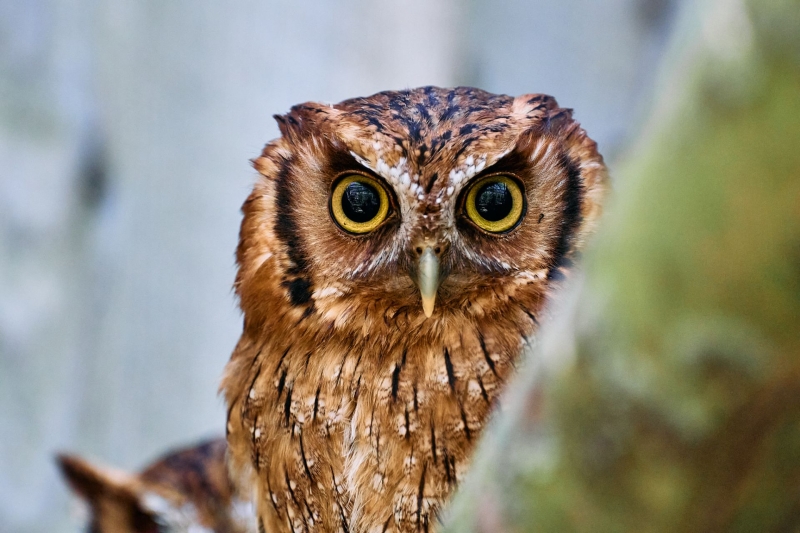
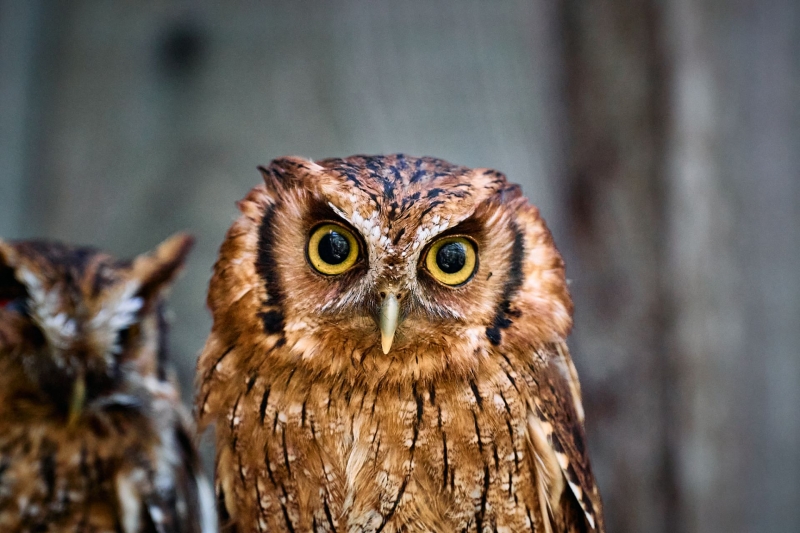
The tropical screech owl is polymorphic, with much variation in color. It is overall gray-brown or (less commonly) brown or rufous, but always with a relatively distinctive blackish edge to the face and yellow irides. Its undersides are pale with a black "herringbone" pattern. There are no significant physical differences between male and female tropical screech owls.
The tropical screech owl's primary song is "short, purring trill, followed by two accentuated clear notes". The female's song is similar to the male's but higher pitched. A secondary, courtship, song is "a bubbling bububúbubu". They also produce "a variety of cackles and longer hooting notes.
The tropical screech owl nests in holes such as natural cavities, old woodpecker holes, and nest boxes. The clutch size is usually one to three but can be as large as six. Adults defend the nest with "fluffing" displays and aggressive moves.
Conservation
The IUCN has assessed the tropical screech owl as being of least concern. It is common in much of its large range, and deforestation may actually benefit it because it provides the more open habitat it frequents.
Adopt this Tropical screech owl